Research Information Systems Engineering
RISE is a public knowledge base introducing Research Information Systems Engineering — a framework for designing, operating, and governing AI-enabled research systems: information systems whose primary purpose is to produce scholarly knowledge with at least partial mediation by AI agents.
The motivating premise is that GenAI is becoming part of the infrastructure of scientific work, which creates a need for institutional guardrails grounded in a systematic understanding of these systems — their architectures, human roles, provenance mechanisms, failure modes, and evaluation criteria. See Concept → Definition for the full framing.
The repository maintains three curated catalogs:
- an academic-papers database of structured notes on the literature that frames RISE;
- a projects database that evaluates agentic research systems against a standard rubric;
- a skills database of reusable Markdown skill files curated from open agentic-research projects.
The RISE pipeline at a glance
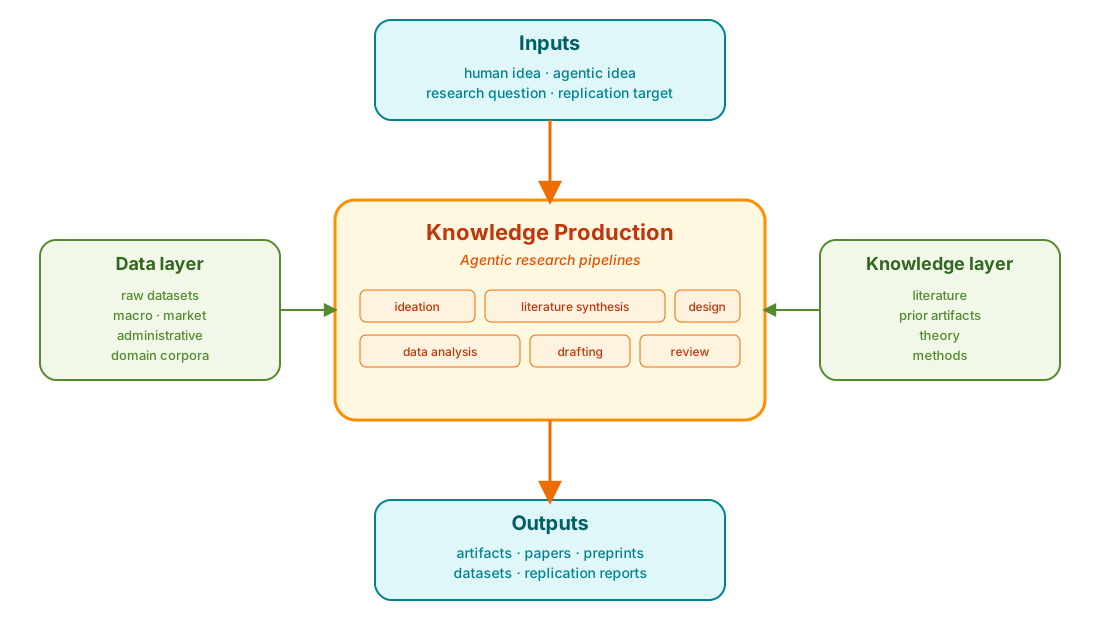
A RISE system is any information system that implements some non-trivial portion of this diagram. Different systems differ in:
- which inputs they accept (some take only a fully specified RQ; others ideate from scratch);
- how broadly they cover the pipeline (single-stage tools vs. end-to-end pipelines);
- how autonomously the pipeline operates (copilot ↔ society of agents);
- what artifacts they produce, and to what reproducibility standard.
The projects catalog scores every system on these dimensions using the evaluation rubric.
How to use this site
| If you are… | Start at |
|---|---|
| New to the topic | Concept → Definition |
| Looking for the diagram explained | Concept → Pipeline anatomy |
| Surveying existing systems | Projects |
| Looking for the literature | Papers |
| Looking for reusable agent skills | Skills |
| Wanting to contribute | Contributing |
| Wanting to cite this site | About / Cite |
Provenance
This knowledge base is curated by Björn Hanneke (Goethe University Frankfurt), with research and evaluation supported by Claude Code (Anthropic) — project audits, paper-note drafting, PDF-text extraction, and rubric scoring are produced through Claude Code workflows under the curator's review.
Hobby project — not (yet) a scientific contribution. RISE is a living catalog assembled in the open. Claims, scorings, and classifications reflect the curator's current best-effort understanding of fast-moving primary sources; they have not been peer-reviewed, and the rubric (v0.2) is itself a working artifact. Use it as a navigable map of the field, not as a citable evaluation of any individual project. Corrections and additions welcome via pull request.
Licensed CC-BY-4.0; please cite per
CITATION.cff.